
(before I go on, here is a link to a response that I wrote to somebody recently, which captures some reflections from a while after I wrote this original article and a pseudo-solution for the non-feint-of-heart).
The purpose of this page is to track the research I am doing into the fact that I find the behavior of the throttle on my 2004 Audi S4 unpredictable. In particular, this car has a "drive by wire" throttle. This means the gas pedal ("accelerator" as it is actually called) does not directly control how much gas goes to the engine, which is the case in most cars. Instead, in this car, there is a sensor on the gas pedal which tells a computer how far you have pressed it, and the computer controls a motor in the engine that controls the throttle.Here are quick shortcuts to each major piece of reasearch:
In some cases, there is a significant delay before you accelerate. In other cases, delays can be much shorter, but if they happen while shifting, they cause a jerky ride and burning of the clutch, which is not the driver's fault.
And in the worst case, the car can keep accelerating after you lift the accelerator. Note that lifting all the way always works, it is only partial lifts that are sometimes ignored or have a delayed reaction.
In short, green & yellow are accelerator position, and red & blue are throttle position. These values have all been adjusted & normalized b/c the real values in the car don't actually rage from 0-100.
In all of these graphs, green and yellow show acccelerator position. There are two sensors that measure it. They agree on my car, so you often can only see one b/c the the other covers it. Note that I have adjusted the graph to show a 100% scale. In truth, the sensors read from about 14% to about 76%. Also the reason one is called "accelerator50" is that this sensor is actually designed to read in values that are half what the other sensor reads. This has also been adjusted.
Red and blue show actual throttle position. Similarly to above, you can usually only see red. Thes have also been adjusted. The real ranges are about 14-86%. The second sensor is called "throttle0" because it actually reads the opposite of the first (it tells you "how closed the throttle is." So, it's "maximum" theoretical value is actually zero. I've adjusted this as well.
Note also that in some graphs you may see rpms drop below what appears to be idle. This is real. I did much of my testing at or below 1000 rpms, in 6th gear. This was deliberately to put the engine at as low as possible a power output, so I could get several seconds of data without ending up at an absurd speed.
RPMs are the thick white line.

Notice that RPMs continue to rise steadily as the throttle is lifted, for a little while (about a full second).
Mid-rpm Throttle Doubling
Another discovery I've had is that in some cases, full throttle can be
activated by as little as half accelerator usage. In other words,
pushing the pedal half way down gets you full throttle. Pushing it more
does nothing, and lifting can still result in continued acceleration.
This isn't surprising, think of it like this: 50% accelerator gave you max
throttle. you keep pushing to say 80% accelerator - you still have max
throttle. Now you lift to say 60% accelerator - but that's still past what
was giving you max throttle. So, you think you told it to slow down, but it's
still speeding up.
I've only researched this breifly. It appears to be RPM depenedant; at higher rpms, it appears to take closer to 100% accelerator to get 100% throttle, but at this point I need to collect more data. Also, I apologize, but I forgot to actually collect RPM data on this run (I was actually going somewhere, the data collection was an afterhought).
Following are two different graphs showing that far less than 100% accelerator can still give you 100% throttle
note: In these graphs I have improved my scaling of the values, so "no pedal/ no throttle" now both show up as zero.


Delayed Reaction
This problem happens primarily when the car is moving. It is
easiest to reproduce when coasting, with the engine at idle, but
that is not the only time it happens. This problem has three versions:
You might be wondering why you would ever be at idle while moving. Sometimes it is simply that you are downshifting from low rpms, and it drops to idle while you're getting into the next gear, and you want to rev the engine a little so disengaging the clutch doesn't make the car buck. Being in heavy traffic is one reason. Going around a tight corner is another, sometimes you have to go too slow to actually be in a gear. Or if you're in first gear it's too easy to accidentally jerk the car around, and it's safer to coast.
 Here we have a delayed response where the throttle opens much slower
than requested at first, and then suddenly catches up. Here are
three examples of me "blipping & pressing" to match the engine's revs to the car's
speed. This is what you would do to quickly get the engine to speed (moderate
throttle) and then hold it at that speed (less throttle).
Here we have a delayed response where the throttle opens much slower
than requested at first, and then suddenly catches up. Here are
three examples of me "blipping & pressing" to match the engine's revs to the car's
speed. This is what you would do to quickly get the engine to speed (moderate
throttle) and then hold it at that speed (less throttle).The first two exhibited immediate (0.1 sec) response. The third one gave only about 5% response, which was effectively nothing, and the revs didn't respond. Then as I pressed (more than normal, which is the subconscious reaction to the fact that the blip had no effect), there was a significant delay (about 0.4 sec) between my press, and a proportional response from the throttle. Not the difference in behavoir of the revs between the 3rd & the other two. It took 1.75 sec to get the engine to 1500 rpms, vs. 0.4 sec the other two times.
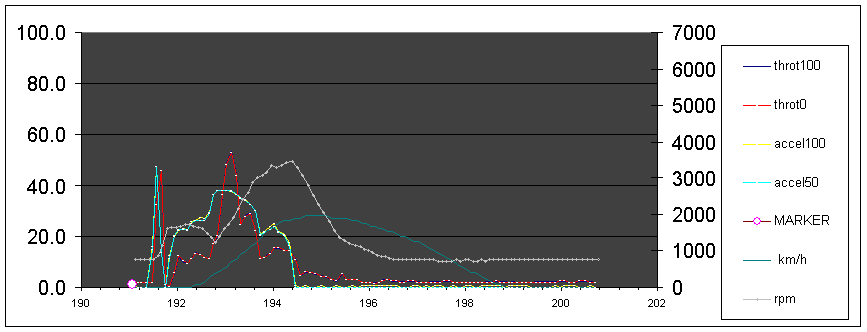 Here we have unexpectedly low response. This is me starting in 1st gear
from a standstill. I blip the throttle to get some revs, and successfully
get th engine to about 1500 rpms. I begin to engage the clutch, and come
back with 25-30% pedal application. The engine responds with very little
power, and as you can see, only about 12% throttle. It feels like I have
a wimpy engine, and revs start to drop
because the clutch is overpowering the engine. I increase the pedal from
26% to 38%, and the throttle suddenly overreacts, going from 15% to 55%.
Here we have unexpectedly low response. This is me starting in 1st gear
from a standstill. I blip the throttle to get some revs, and successfully
get th engine to about 1500 rpms. I begin to engage the clutch, and come
back with 25-30% pedal application. The engine responds with very little
power, and as you can see, only about 12% throttle. It feels like I have
a wimpy engine, and revs start to drop
because the clutch is overpowering the engine. I increase the pedal from
26% to 38%, and the throttle suddenly overreacts, going from 15% to 55%.
In this case, the exact application of my clutch allowed the clutch to spin as the engine revved, so the resulting acceleration was smooth, but very hard on the clutch, and resulted in the 'burnt clutch smell'.
 Here we have unexpectedly low response. This occured after engaging 2nd gear.
At 4392 secs I accelerate in 1st gear, to about 15 mph. Then I declutched,
and depressed the pedal to engage second. I accidentally gave too much, so
I backed off, and came back with an appropriate amount. At 4395 sec, I backed
off to about 8% pedal. The engine responded with 0 & throttle, so it backed off
too much. Then I came back on with 30% pedal, and the engine only gave me 15%
throttle. This felt like the car was "falling on it's face" to quote another
owner; like I suddenly had a 1.8 liter 4 cylinder engine.
Here we have unexpectedly low response. This occured after engaging 2nd gear.
At 4392 secs I accelerate in 1st gear, to about 15 mph. Then I declutched,
and depressed the pedal to engage second. I accidentally gave too much, so
I backed off, and came back with an appropriate amount. At 4395 sec, I backed
off to about 8% pedal. The engine responded with 0 & throttle, so it backed off
too much. Then I came back on with 30% pedal, and the engine only gave me 15%
throttle. This felt like the car was "falling on it's face" to quote another
owner; like I suddenly had a 1.8 liter 4 cylinder engine.